
Elk County Projected Versus Actual Release
A projected date is a planning date based on the sentence and facts known at that point. An actual release date records when custody ended. The two can differ. Sentence-credit corrections, another court order, a detainer, parole action, misconduct consequences, a new case, or recommitment after a violation may alter the practical result.
Custody status determines whether a calculated date exists at all. A pretrial detainee has not received a final confinement sentence in that case. Release may depend on bail being satisfied, dismissal, a plea or sentence, or another court order. Even when bail is posted, a hold from another authority can block departure. Elk County Prison and the Unified Judicial System docket are the sound sources for that county case.
A sentenced state prisoner generally has a court-imposed minimum and maximum. The minimum is the first ordinary parole-eligibility point, not an assured exit. The maximum is the outer judicial term, subject to the legal effects of such matters as recommitment. Pennsylvania DOC calculates sentence dates from sentencing documents and credit. Where the Pennsylvania Parole Board has jurisdiction, the Board decides whether parole release occurs.
Choose the Elk County Release Route
The first question is not which date field to search. It is who holds the person now. Elk County Prison is a county institution, while the Pennsylvania DOC locator covers current DOC jurisdiction and current state supervision. A person held only at the county prison may never appear in the state locator. A transfer from Elk County to a state correctional institution changes the correct search route without proving release to the community.
| Custody situation | Best date source | Key limit |
|---|---|---|
| Pretrial at Elk County Prison | Elk County Prison and UJS docket | No fixed sentence-release date may exist. |
| County sentence | Prison records and sentencing docket | PA DOC does not cover county-only custody. |
| Current state prisoner | PA DOC inmate locator, DOC calculation, and docket | A minimum date is eligibility, not guaranteed release. |
| Released to state parole | DOC supervised-individual locator | The “Release Date” field concerns current supervision data. |
| Fully discharged state case | UJS docket and DOC records request | The current locator is not an archival discharge list. |
For Elk County custody, call the prison at 814-776-5342. Ask whether the person is still held and which office can confirm a sentence computation. Staff may limit what can be disclosed by phone. A documentary request can seek the existing release date, commitment and discharge entry, or custody calculation, while the court docket supplies the sentence and later orders.
For state custody, the PA DOC Inmate/Department Supervised Individual Locator is the current public route. Choose its inmate mode for someone in DOC custody. Choose its supervised-individual mode after release to state parole. The split is crucial because a parolee can move from the inmate side to the supervised side.
Find an Elk County Release Date
Build the answer from the correct custody source and the court record. A single “not found” message cannot establish release. It may mean the search is too narrow, the person is county-only, the agency has not updated its data, or DOC jurisdiction has ended.
- Identify the last known facility and decide whether the case is pretrial, a county sentence, or a state sentence.
- Search the UJS docket for Elk County sentencing entries, bail events, credit, amended orders, and later case activity.
- For county custody, call Elk County Prison and request an existing calculation or release-related record when written proof is needed.
- For state custody, open the PA DOC locator, choose inmate or supervised-individual mode, and search by inmate or parole number when known. Otherwise begin with the name.
- Compare date of birth, committing county, number, and location before accepting a state result as the correct person.
- Confirm the date with the responsible agency and register for a custody-change alert if notice of the actual event is needed.
The official PA DOC inmate and supervised-person search shows the two current locator modes and their available search fields.
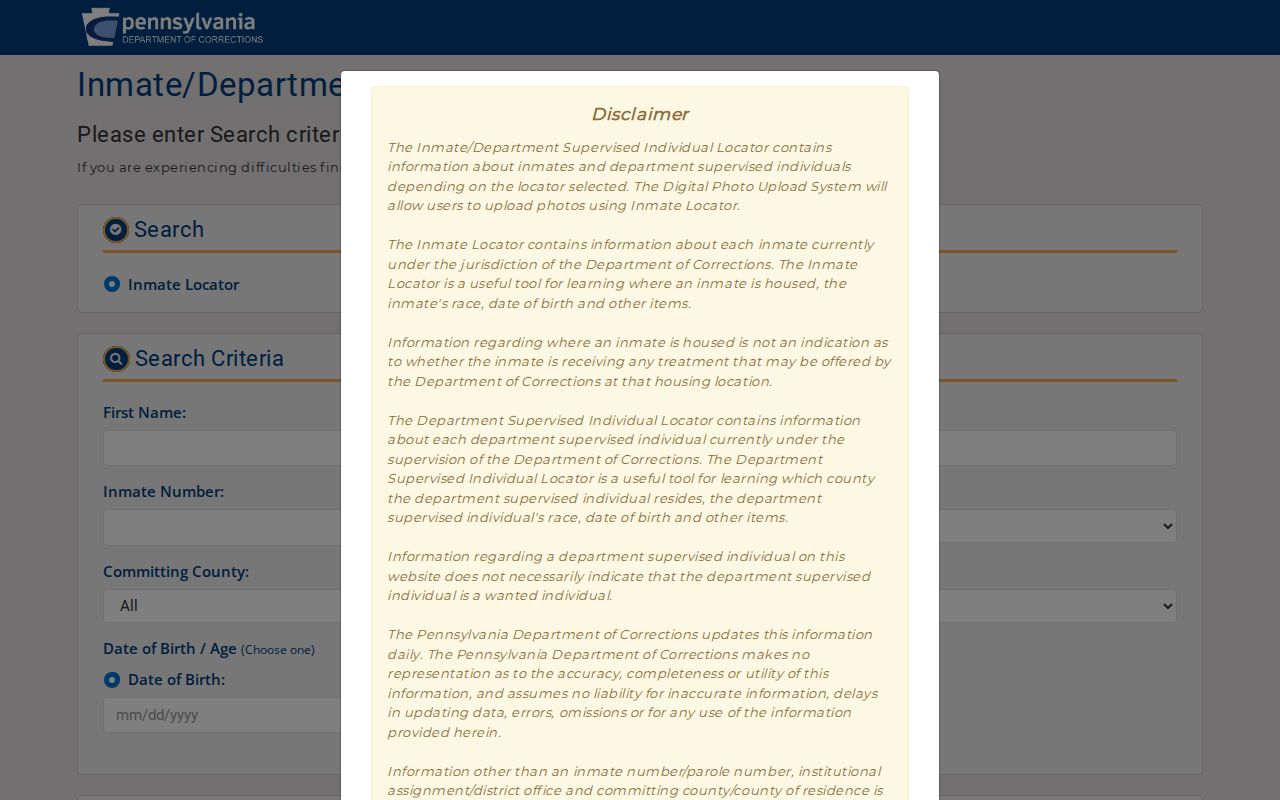
The locator supports names, inmate or parole numbers, gender, committing county, location, citizenship, date of birth, and approximate age. DOC advises trying only the last name when a restrictive search fails. Results can be sorted by name, inmate number, birth date, committing county, or location.
The supervised-individual mode includes a field labeled exactly “Release Date” for a person currently under DOC supervision. Do not recast that field as a universal projected date. A person who completed supervision may disappear because the portal shows current state custody and supervision, not every historical discharge.
Elk County Minimum and Maximum Terms
Under 42 Pa.C.S. §9756, a Pennsylvania court ordinarily sets a minimum and maximum for total confinement, subject to statutory exceptions. The minimum ordinarily marks when parole can first be considered. It does not order release. The maximum is the sentence's outer term, although recommitment and other legal events can affect the calculation.
The Pennsylvania Parole Board reviews parole where it has authority. Reaching the minimum does not compel the Board to approve release. A denial can keep the person confined toward the maximum, while a later review may lead to a new decision. Court-imposed terms and the Board's release decision are therefore separate parts of the projected date.
The Pennsylvania Parole Process explanation directly addresses minimum and maximum dates and rejects the common 85% claim.
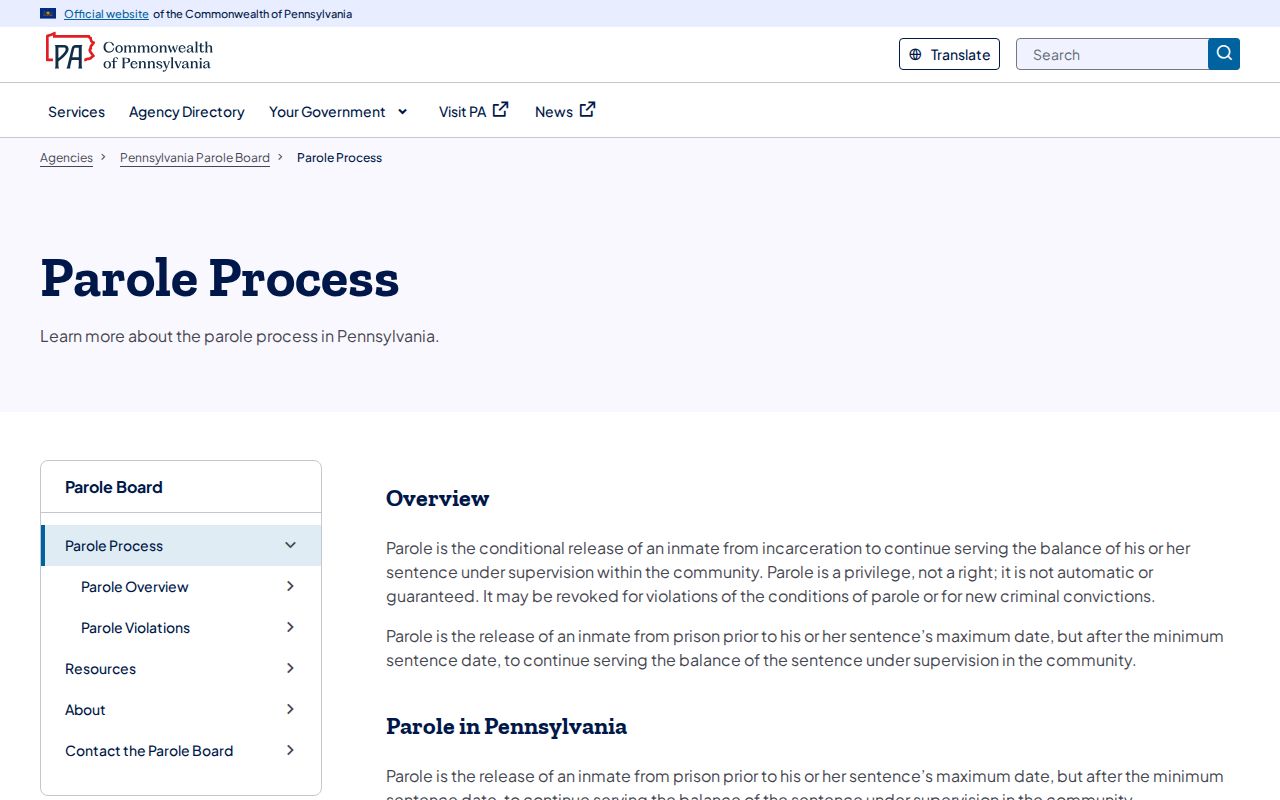
The state source confirms that Pennsylvania does not require a person to serve 85 percent of the maximum before parole. Ordinary parole eligibility begins with the judicial minimum, while release still depends on the governing process and the facts of the case.
- Minimum term
- The first ordinary point at which parole may be considered, not a promised release date.
- Maximum term
- The outer court-imposed confinement term before applicable legal adjustments.
- Parole
- Conditional release while the remaining confinement sentence is served under supervision.
- Detainer
- A hold or request from another authority that can prevent release from becoming community departure.
Elk County RRRI Release Dates
Pennsylvania has no universal good-time percentage that mechanically cuts every sentence. RRRI, the Recidivism Risk Reduction Incentive, is a specific statutory route for eligible cases. Other program-specific rules, including the official JRI2 Act 115 information, must be tied to the actual record rather than converted into a statewide percentage. RRRI creates a different minimum, not a blanket reduction of the sentence and not a guaranteed release date.
Under 61 Pa.C.S. Chapter 45, the RRRI minimum is three-fourths of an imposed minimum of three years or less. When the imposed minimum is more than three years, it is five-sixths. Consecutive terms are combined for the calculation, and partial days round as the statute directs. RRRI does not shorten the judicial maximum.
Eligibility is constrained by the statute. The sentencing court addresses eligibility, and exclusions concern specified histories and offense categories. DOC must evaluate ongoing eligibility, program completion, conduct, and certification requirements. The Parole Board then makes the release decision required by law. An RRRI date is therefore an earlier potential minimum for an eligible and certified person, not a self-executing discharge day. The PA DOC RRRI explanation provides the official program context used for these calculations.
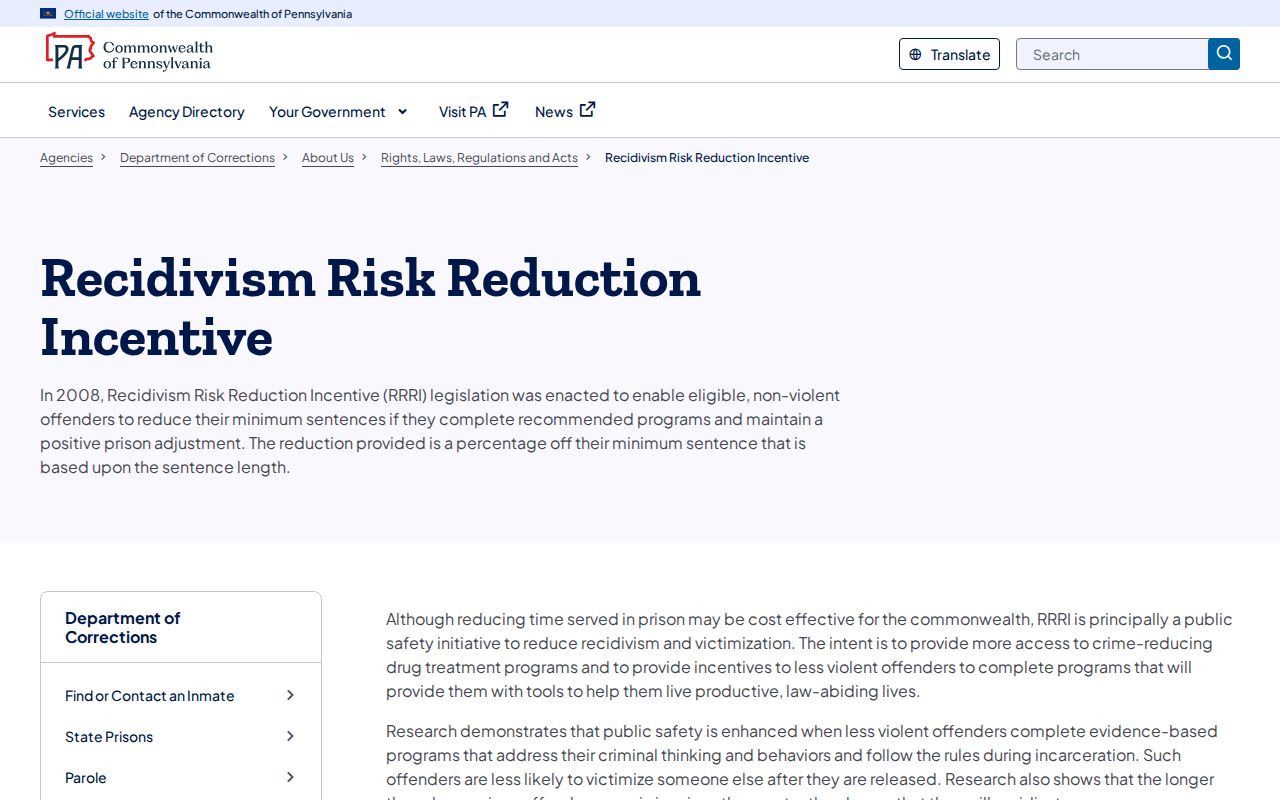
The DOC source places RRRI within an eligibility, program, conduct, certification, and Board-review framework. That context is why a computed fraction alone cannot confirm when release will happen.
Note: Confirm RRRI eligibility and certification in the actual case record before treating a calculated RRRI minimum as relevant to an Elk County release.
Elk County Has No 85% Rule
Pennsylvania's official parole guidance expressly states that state inmates do not have to serve 85 percent of their maximum sentence before parole. That percentage should not be used to estimate an Elk County projected release date. The lawful baseline is the court's minimum and maximum, paired with the parole statutes and any applicable RRRI determination.
There is also no universal state good-time rate that removes the same share of days from every Pennsylvania sentence. County and state cases must not be reduced by a borrowed percentage from another jurisdiction. For an Elk County Prison sentence, request the actual county calculation and read the sentencing docket. For a state sentence, rely on DOC's computation and the Board's decision process.
This distinction prevents two common errors. The first is multiplying the maximum by 85 percent and calling the result a release day. The second is subtracting a generic good-time award without knowing whether any Pennsylvania program applies. Neither method is supported by Elk County or Commonwealth sources.
RRRI is different because the statute supplies defined three-fourths and five-sixths calculations for eligible cases. Even then, the calculation changes an early minimum route rather than guaranteeing release or shortening the judicial maximum.
Why Elk County Release Dates Change
A date may move because the custody agency receives new facts or because the legal posture changes. The most reliable review connects the court docket, the responsible agency's calculation, and the current custody status. Each source answers a different question.
| Change | Possible effect on release | Where to confirm |
|---|---|---|
| Sentence-credit correction | Moves a computed minimum, maximum, or practical date. | Sentencing entries and the responsible custody agency. |
| Amended court order | Changes the terms used by the agency. | UJS docket and certified court record. |
| Consecutive sentence | Adds terms that must be aggregated. | Judgment of sentence and agency calculation. |
| Detainer or hold | Can block community departure after one custody basis ends. | Holding agency and the authority that placed the hold. |
| Parole grant or denial | Determines whether release occurs after eligibility or confinement continues. | Pennsylvania Parole Board record. |
| Misconduct or program result | Can affect certification or the practical release route. | DOC record and applicable decision. |
| New case or recommitment | Adds custody or recalculates time after a violation. | Court, Board, and custody records. |
A transfer can also be mistaken for release. Someone moved from Elk County Prison to PA DOC has left the local building but remains incarcerated. A state parole release moves the person from prison custody to conditional supervision. A final discharge ends that supervision. Those events have different records and should never be collapsed into one date.
Confirm Elk County Actual Release
PA SAVIN can provide the custody-change alert after a date has been estimated. Elk County's local participation covers release, transfer, furlough, and escape events. Register against the correct person and read the event label carefully. The Elk County VINELink inmate search explains the four-digit PIN and acknowledgment steps.
For county custody, confirm with Elk County Prison and the court docket. A written county request can seek an existing booking or release record, commitment and discharge sheet, recorded release date and time, disposition, and transfer destination if those fields are maintained. Do not ask the county to create a new calculation or narrative that does not exist.
For state custody, compare the DOC locator with the sentencing docket and request an existing DOC record when the current portal no longer shows the person. Supply the full name, DOC number, date of birth, and date range. A current supervised-person “Release Date” proves a state release into current supervision, while an old fully discharged record may require the formal route.
Actual release is confirmed by the custody event, not by arithmetic alone. A minimum, an RRRI fraction, or a docket order can guide the search, but the responsible agency's record establishes what happened after all holds and decisions were applied.
Note: A court order may explain release authority, while a custody record confirms whether the person physically left or transferred elsewhere.